STATUS:
LIVE
Snap&Go
Product Design
Design System
Framer Development
UX Strategy
User Flows
Redesigned the end-to-end quote experience, introduced AI-assisted package dimension capture, simplified user flows, and created a scalable design system.
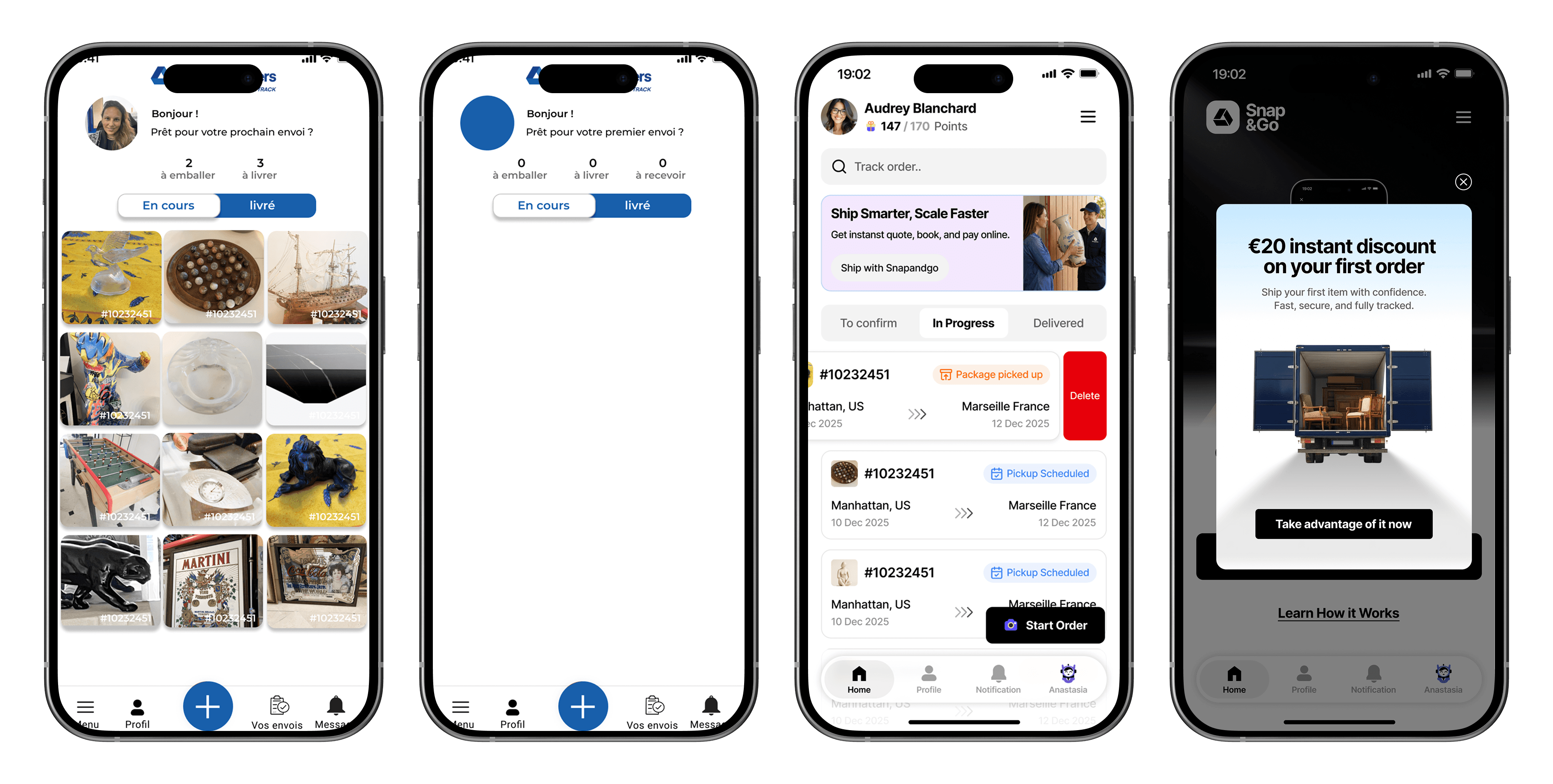
Snap&Go is one of the two flagship solutions by ThePackengers. I initially joined the project to design the mobile app's high-fidelity UI, but as the project progressed, I uncovered several UX issues that led to a complete redesign of the product experience. Beyond the app, I also designed and developed the marketing landing page in Framer and created the app's email templates to deliver a consistent experience across every touchpoint.
ROLE
Founding Product Designer and Framer Developer
DURATION
~1 year, in parallel with 6 other products
TEAM
Product Owner · PM · Frontend & Backend Engineers
4
steps from 7+ screens order flow
360
localized screens, EN / FR
1
designer, end to end
3
iterations

THE CHALLENGE
The product was still being discovered.
The app's core user flow wasn't finalized, and features were frequently added, removed, or changed as the product evolved. The initial wireframes also didn't follow established UX patterns, so many flows had to be rethought rather than simply designed. On top of that, every screen had to work in both English and French, which required careful planning since French translations were often much longer than their English counterparts.
The team had:
Rough and incomplete wireframes
Evolving product requirements
No design system or reusable component library
No established UX patterns
Frequent changes in direction as the product matured
MY ROLE
Owning the end-to-end design process.
Defining user journeys from evolving requirements
Redesigning flows/screens that did not follow standard UX
Improved onboarding by setting up user's expectation of how the app works
Redesign
Designing edge cases and interaction states
Supporting implementation through design QA
Bilingual experiences for English and French users
Close collaboration with product owners and engineers
PROCESS
Creating clarity before design.
Rather than immediately focusing on UI, I first worked to understand how users would move through the product. Because requirements frequently evolved, every feature required translating business conversations into practical workflows engineering could build. This meant continuously refining user journeys, validating assumptions with stakeholders, and designing interaction patterns that balanced usability with technical feasibility. By creating clarity before polishing interfaces, the team iterated quickly without losing consistency.

WHAT I DID
Structure where none existed.
180+
screens on one shared foundation
Established the product foundation
One of my earliest priorities was building a scalable design system rather than designing screens independently. This gave the team a shared visual language, reduced inconsistencies, and let future features reuse existing patterns instead of starting from scratch.
70%
fewer engineering clarification requests across the TPK ecosystem
Reduced engineering ambiguity
Instead of delivering only happy-path screens, I designed interaction states, edge cases, and alternate scenarios so developers could implement with confidence. I also introduced collaboration workflows that made clear which designs were still being explored and which were ready for development — practices that carried across every product I designed at ThePackengers.
360
localized screens, designed as pairs from day one
Designed for localization
Supporting English and French introduced real layout challenges — translated content often needs significantly more space. Rather than treating localization as a final step, I brought French content into the design process early, so layouts and components adapted without extensive redesign later.
MVP,
not MVP debt
Balanced speed with long-term scalability
As a startup, shipping quickly mattered. Instead of over-designing early iterations, I focused on reusable foundations that let the team move fast while supporting future growth — validating the product without creating unnecessary design debt.


OUTCOMES
2
platforms launched — iOS & Android
2
languages, consistent from day one
260k+
users across the ecosystem it joined
1
scalable design system powering future products
The project resulted in a successfully launched AI-powered logistics MVP — 180+ screens, fully bilingual on a design system that now supports ThePackengers' wider product development. Clearer collaboration between product, design, and engineering, and modern interfaces aligned with the company's vision as a technology-driven logistics startup.
REFLECTION
What I learned
Designing an MVP isn't about creating perfect screens, it's about reducing uncertainty. When requirements evolve constantly, the designer's role extends beyond interfaces: helping teams make decisions, creating structure where none exists, and building products that adapt as the business grows.
What I'd do differently
Spend more time validating post-launch assumptions through user research and product analytics, so future iterations are guided by real customer feedback.

